Trillion-Parameter Models, Grade-School Math Failures: The Chasm Between AI and AGI
AI can write poetry and generate photorealistic images, yet it can be stumped by a math problem a child can solve. This isn't just a technical glitch; it's a profound clue about the nature of intelligence. We explore the massive gap between today's AI and true AGI through the lens of three distinct minds: the rote-learning Student, the intuitive Driver, and the law-discovering Newton, offering a clear guide to what AI can do now—and what it still can't.
10/5/20254 min read
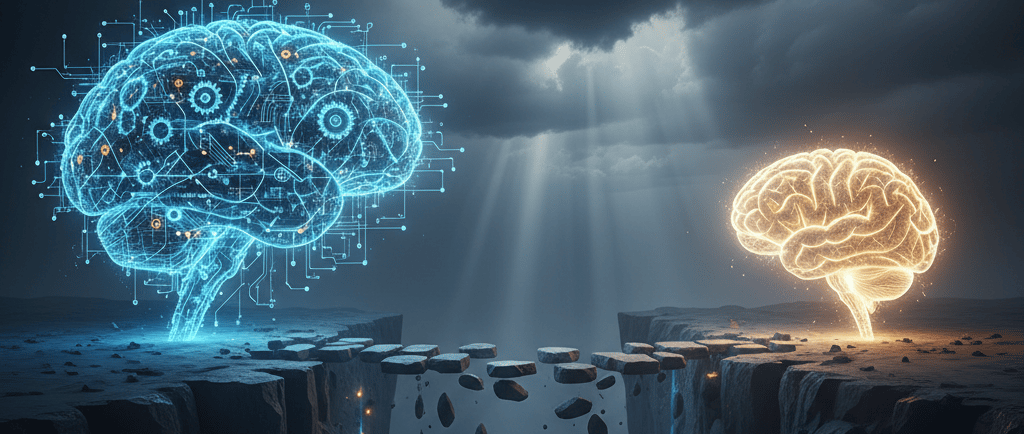
Every week, it seems, we witness another quantum leap in artificial intelligence. Trillion-parameter models generate breathtaking images from a few words, write complex code in seconds, and discuss philosophy with startling fluency. The pace of progress is so dizzying that it's easy to believe that Artificial General Intelligence (AGI)—a truly human-level intellect—is just around the corner.
But what if I told you that this entire narrative is missing a crucial piece of the puzzle? What if these same "genius" models can be stumped by a math problem a ten-year-old can solve?
This isn't just a quirky flaw; it's a window into the vast chasm between the AI we have today and the AGI we dream of. To truly understand this gap, we need to look past the impressive demos and see AI not as a single entity, but as a technology evolving through distinct stages.
In this article, we'll explore the three minds of AI—The Rote-Learning Student, the Intuitive Driver, and the Law-Discovering Newton—to understand where we truly are on the long road to AGI.
1. The Student: A Rote Learner with a Perfect Memory
Today's Large Language Models (LLMs) are best understood as students who have memorized every book in the library but haven't learned how to think from first principles. By processing vast swaths of text, they have become incredibly sophisticated pattern-matching systems.
This is why they seem so knowledgeable. But it's also why they can be surprisingly brittle. A 2025 research paper, "Why Can't Transformers Learn Multiplication?", brought this issue into sharp focus, stating that, "Despite having billions of parameters, models like Llama-3.2 90B or GPT4 still fail at 4x4-digit multiplication..., even when explicitly fine-tuned on the task".
The reason for this failure is that the model doesn't learn the actual procedure of multiplication. Instead, the study found that under standard training, "the model converges to a local optimum that lacks the required long-range dependencies". In other words, it gets stuck just memorizing the easy parts of the problem without ever grasping the full algorithm. The researchers conclude that this reveals a fundamental "pitfall of the standard recipe for training language models... [it] does not encourage the model to learn the right long-range dependencies".
This is the classic hallmark of a rote learner. They can provide answers that look correct based on patterns they've seen before, but they lack the underlying procedural understanding to solve a novel, multi-step problem. This reveals the first major gap on the path to AGI: moving beyond knowing what to developing a true understanding of how and why.
2. The Driver: An Intuitive Practitioner of Reality
If the Student learns from books, the Driver learns from the road. This next stage of AI, which we're just beginning to explore with technologies known as "World Models," is about building an intuitive, predictive understanding of the real world.
Think of an experienced truck driver. They may not be able to write out the equations for friction and momentum, but after thousands of hours behind the wheel, they have a deeply ingrained, intuitive grasp of physics. They can anticipate how a car will skid on a wet road or how much braking distance they need, all based on a mental model of the world built from experience.
This is what World Models aim to achieve. Instead of just learning statistical relationships in text, these AIs learn the "rules" of an environment by observing it and trying to predict what will happen next. We see this emerging in video generation models that need an implicit model of physics to create realistic scenes of motion and interaction. This is a monumental step up from the Student. It's a move from a text-based reality to a physics-based one, creating a more grounded, robust intelligence that can plan, reason, and act within a specific environment.
3. The Discoverer: From Using the Laws to Writing Them
The Driver's intuition is powerful, but it's limited to their experience. The final, and still hypothetical, stage of AI is the Discoverer—an intellect that can move beyond using the rules to deriving them from scratch. This is the leap from being an expert practitioner to being Isaac Newton.
Newton didn't just have a good intuition for how objects fall; he observed the world, found the underlying patterns, and created a new layer of abstraction to describe it: the law of universal gravitation. He built a model of the world that was not just predictive, but fundamental.
This is the grand challenge of AGI. A true AGI would not just learn from data; it would generate new, fundamental knowledge from that data. It could observe a complex biological system and derive the principles of evolution, or analyze market data and discover new economic laws. This type of abstract reasoning—the ability to create simple, powerful explanations for complex phenomena—is what separates even the most advanced "Driver" from a mind that can genuinely think, reason, and create across any domain.
Conclusion: The Long Climb Ahead
So, where are we now? We are firmly in the age of the Student. These trillion-parameter models are incredible tools, but their "grade-school math failures" show us they are not thinking in the way we are. We are just now taking the first steps into the world of the Driver, building AIs that have a common-sense, intuitive grasp of reality.
The Discoverer, however, remains far on the horizon. The chasm between the AI we have and the AGI we imagine is the gap between reciting knowledge, applying it intuitively, and discovering it anew. Closing that gap is the single greatest challenge and the most exciting frontier in science today.